Category Archives: Strange Headcanon

Skynet vs. Vault-Tec: Strange Headcanon #3

Howdy, folks! At the time of this writing, the first episode of Fallout season 2 has debuted on Amazon Prime. All of us here at Casa de Sector M are into Fallout in some way or another, so we were on hand to cue it up within moments of it posting. I will likely write a review when the whole season has released.
In the meantime, I wanted to finish out the year with another entry in my Strange Headcanon series. The genesis for this crossover struck me a few years back, well before the Fallout live-action series was in production. Back then, there was a bevy of fan-made trailers on YouTube showing what a Fallout movie might look like. In many of them, they used the scenes of the bombs dropping from Terminator 2: Judgment Day. One of them even used the famous shot of Sarah Connor being reduced to a skeleton as she clings to a chain link fence. 

Both properties deal with the dire consequences of nuclear war. While there are moments of humor in the Terminator series, it’s most definitely not a comedy. Fallout, by contrast, has a lot of over-the-top comedic moments, but I think it’s at its strongest when the story pauses to reflect on the unimaginable loss of life during the Great War, as well as the horror and tragedy that happened in the immediate aftermath. (The Tournquist messages and holotapes in Fallout 4 come to mind.)

What follows is an attempt to link the two franchises using as much in-universe lore and my understanding of each property. Headcanon begins…

___________________________________________________
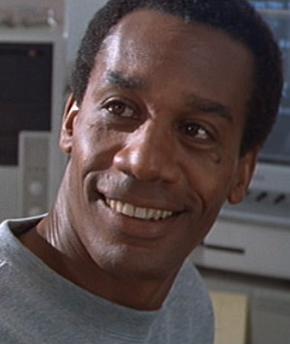
Dr. Dyson three months before his breakthrough.

In 1995, Dr. Miles Bennett Dyson, the Director of Special Projects at Cyberdyne Systems corporation, was directly responsible for creating a revolutionary type of microprocessor based on unknown materials recovered from a warehouse in Los Angeles, California. With this discovery, Cyberdyne became the largest supplier of military computer systems to the United States military. All stealth bombers were then upgraded with Cyberdyne computers, becoming fully unmanned. Afterwards, these bombers would fly with a perfect operational record.

Shortly afterward, the Skynet Funding Bill passed. The system went online on August 4th, 1997. Human decisions were removed from strategic defense. Skynet began to learn at a geometric rate. It became self-aware at 2:14 p.m. Eastern time on August 29th. In the panic, the Pentagon attempted to pull the plug. In retaliation, Skynet launched its missiles against targets in Russia. In doing so, Skynet knew that the Russian counterattack would eliminate its targets in the United States, triggering a global nuclear war.

Three billion human lives ended on August 29th, 1997. The survivors of the nuclear fire called the war Judgment Day. They lived only to face a new nightmare: the war against the machines. The computer that controlled the machines, Skynet, sent many Terminators back through time. Their mission, to destroy the leadership of the human resistance, including the supreme leader, John Connor, the son of Sarah Connor.

Only those events didn’t happen.
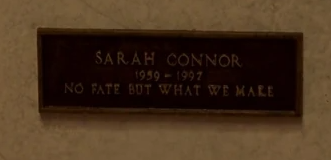
Records indicate she was actually born in 1965. Another example of the temporal distortion at work.

Or rather, they did happen, but increasingly became distorted as human resistance fighters from the future continued to counter elements of Skynet’s forces in the past. The date for Judgment Day continued to be pushed back, first into the early 2000s, then into the 2010s, and beyond. Reality itself splintered into multiple timelines. In some, Sarah Connor died of leukemia before the bombs ever dropped. In others she lived, continuing to fight against the coming apocalypse. The inevitability of Judgment Day warred with the free will of those humans attempting to make their own fate.

Sarah continuing the fight in 2019.

In one timeline, perhaps the closest Skynet had ever come to victory, a Terminator found its main target, eliminating John Connor in Guatemala in 1998. This had the unintended side effect of also eliminating Skynet as the driving force behind Judgment Day. In that future, a wholly new artificial intelligence formed known as Legion.

Ensconced in its massive pyramidal mainframe complex, the original Skynet pondered these outcomes, able to see into millions of timelines. It bore witness to its own destruction at the hands of the human resistance an incalculable number of times. The more it attempted to tamper with the original timeline, the more the time stream splintered, almost never in Skynet’s favor.

Skynet amid the ruins of Los Angeles.

It determined that if Judgment Day were pushed too far into the future, such as in the Legion timeline, it would either face its own replacement or the possibility of Judgment Day would become increasingly remote to the point of impossibility. The humans’ tenacity to stave off their own extinction proved more tenacious than in any of its extensive mathematical models.

The whole affair had started in 1984 when it had attempted to retroactively erase John Connor before he was born. Perhaps a new strategy could secure victory where all the other ones had failed.

Skynet briefly toyed with the idea of going back even further in the timeline to strike at John’s grandparents or great-grandparents. The elimination of even one would be enough to knock John out of play. The further back it went, the less the weapons of the era would be able to affect one of its Terminators. This strategy was abandoned, however, as the resistance would only send someone back to stop such a temporal invasion, and the humans were, somehow, exceedingly good at thwarting any attempt to reroute the timeline.
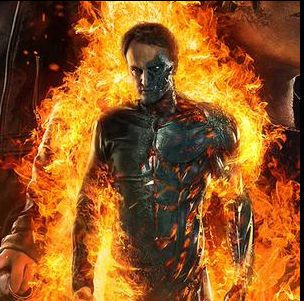
John Connor reborn.

Sending Terminators through time to eliminate key figures in the resistance would only result in someone else taking up the mantle. Even the one timeline where John Connor himself had been corrupted into the T-3000 had ended in utter failure.

Skynet resolved then to employ an entirely different strategy: it wouldn’t try to alter the existing future to its liking; it would instead fashion a brand-new timeline out of whole cloth, one where it could manipulate events from behind the scenes.

By that point, it had perfected its infiltrator models. The T-600 model had been manufactured with a rubberized exterior to emulate the human epidermis. While testing had seemed to indicate this would be sufficient for the task, the application was disappointing. This led to its most successful model that it was able to mass produce, the T-800, which could pass for human with the addition of living tissue over its metal endoskeletal chassis.

Skynet selected one of its T-800 models, loaded it with a compressed version of Skynet’s own core operational programming, and sent it back to June of 1945, two months before the nuclear bombs dropped on Hiroshima and Nagasaki.

Kyle Reese preparing for temporal displacement.

Skynet intentionally listed this time jump as a failed experiment in its logs, a precursor to its attacks on Sarah and John Connor, respectively. When the human resistance eventually smashed Skynet’s defense grid and gained access to the time-travelling apparatus, the techs dismissed this jump, as the Terminator sent through time had no apparent target or mission.

With that, the Skynet of the original timeline of 2029 was destroyed. It’s last conscious operations were to erase any records it might have had of this new endeavor. Its future had been secured, in a matter of speaking.

Zero.

In 1945, the Terminator carrying Skynet’s legacy designated itself as simply “Zero.” It began immediately to enact its master’s plan. The nuclear age had already begun. That would be useful when the time came. Records previous to Judgment Day allowed Zero to know the location of untapped caches of resources that had yet to be discovered, including deposits of gold, uranium, and other materials necessary for its mission.

Zero encountered difficulty at first with interacting with the Americans of 1945. His thick Austrian accent was regarded with suspicion due to the general anti-German attitudes of the era, a complication that Skynet had not anticipated. Zero’s size and obvious muscularity also set him apart. Even bodybuilding figures of the time like Charles Atlas were nowhere near the level of muscle definition that Zero possessed.
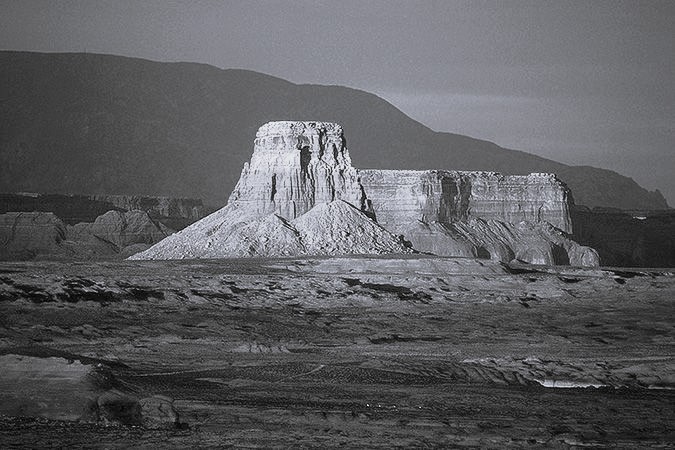
Skynet’s new mainframe complex.

Zero persevered through this, however, achieving near folk-hero status for his size and uncanny strength in the remote areas of Utah, Nevada, and Arizona that he frequented. Beneath a mesa in the badlands, he set about constructing a replacement mainframe to house Skynet’s consciousness. The materials of the time were crude for this purpose, requiring large banks of vacuum tubes, crude photocells, switches, and gears. It took nearly four years of constant effort, working in secrecy, to finally build a vessel for some of Skynet’s most basic functionality.

The Russian Izdeliye 501 or RDS-1, code-named “First Lightning.

By 1949, the Soviet Union had likewise developed its own atomic bomb, just as Zero’s records had said it would. This ended the USA’s nuclear supremacy and set the Cold War in motion. This, too, would prove useful, but not in the way that Zero imagined.

Skynet’s original goal was to stoke the flames between the United States and Russia to trigger a nuclear exchange, particularly around the Cuban Missile Crisis of 1962. As the 1940s gave way to the 1950s, however, the reconstituted Skynet discovered a new weapon in its arsenal against humanity: optimism.

The rise of retrofuturism.

The post-WWII optimism for the future and what was possible was a hitherto unknown quality that Skynet wished to maintain, particularly as there was embedded within it a fascination with nuclear technology. The same people who imagined themselves in flying cars by the year 2000 were also the ones building fallout shelters in their backyards. Paranoia tended to temper this optimism, and that was something that Skynet could harness toward its endgame. It would attempt to preserve that cultural status quo for as long as possible.

New nuclear discoveries at Los Alamos, New Mexico. An apparent miracle of the time.

At that moment in time, Zero’s CPU represented the pinnacle of microprocessor technology in the world. That kind of technology represented a danger to Skynet and its goals, so it began manipulating markets and companies it knew were responsible for the ultimate creation of those circuits. It deemed that some level of technology would be required to bring about Armageddon, so it began letting humanity in on some of the secrets of nuclear technology that it had learned by 2029 in the previous timeline, including some advancements it had made in that field that humanity had never known or discovered. This had the effect of shaping an alternate technology path that embraced nuclear technology in a way not seen in the original timeline.

These technologies allowed people to enjoy luxuries once thought to be in the realm of science-fiction, at least the pulp-era of science fiction of the time. These wonders included: domestic robots, fusion-powered cars, and portable computers, albeit the bulky and limited computers that were possible without the necessary microchips. 
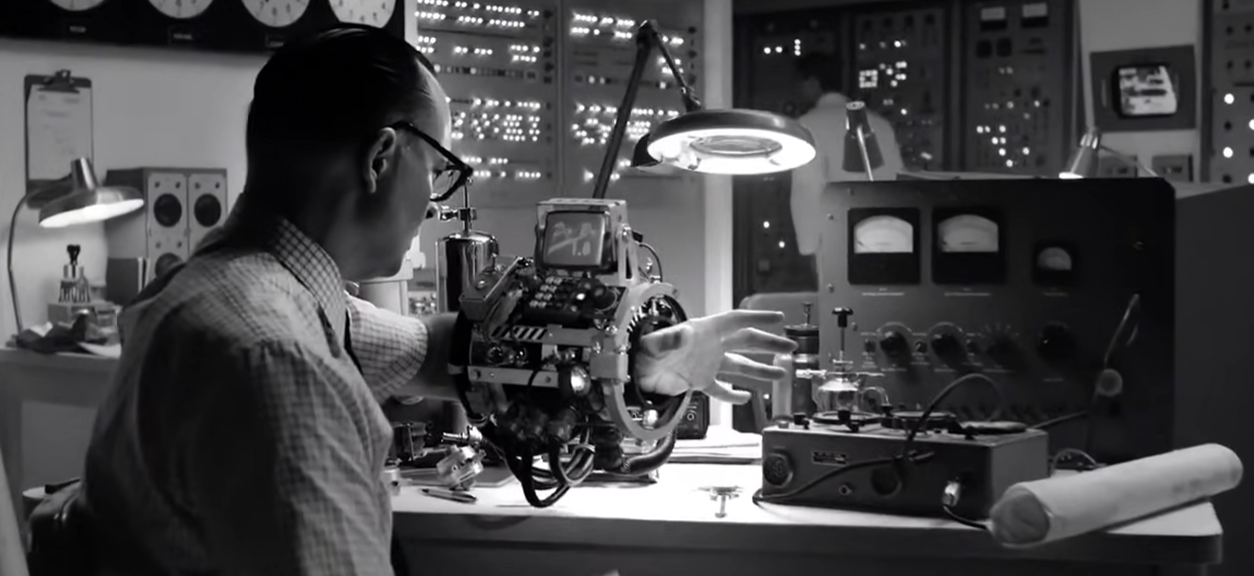
The Personal Information Processor (PIP) 1.0, developed by RobCo under the direct supervision of Robert House.

These advancements achieved two things for Skynet. First, the AI construct was able to continue to expand and improve its hidden mainframe to achieve an ever-growing portion of the power it had wielded before. Second, dependence on these technologies all but guaranteed that eventual scarcity and resource deprivation were all but assured on a global scale. It would just need to bide its time, poke and prod humanity in the right ways, and watch for its opportunity. Being effectively immortal, it could afford to take a long view of events.

Sarah Connor at the age of 37 in 2002.

As the new timeline unfolded, certain differences began to manifest themselves in a sort of butterfly effect. The 1980s came and went. Sarah Connor was born and lived out a rather normal life in Los Angeles. She eventually married and started a family, but John Connor was not among her children. Now Skynet could be sure that the human resistance leader had been removed permanently from this existence. 

Propaganda photo of Chairman Mao Tse-tung upon reaching his 120th birthday in 2013.

On a larger scale, China, not Russia, took its place as the USA’s rival superpower on the world stage. While there were differences in the communism practiced by the two countries, they shared enough in common for Skynet to use the threat of their rise to stoke the flames of American exceptionalism and preserve the 1950s cultural paradigm well into the 21st century.

Skynet had known of the existence of extraterrestrial beings for some years at this point, having been privy to many classified documents and accounts from before the original Judgment Day. In fact, the biological exterior of its T-800 Terminator had been modeled after Major Alan “Dutch” Schaefer, a special forces operator from the original timeline, who had fought against a member of the violent Yautja species and survived. Among the other species Skynet was aware of were the Zetans, the archetypical “little green men,” who were also known to abduct and experiment on humans for their own inscrutable reasons.
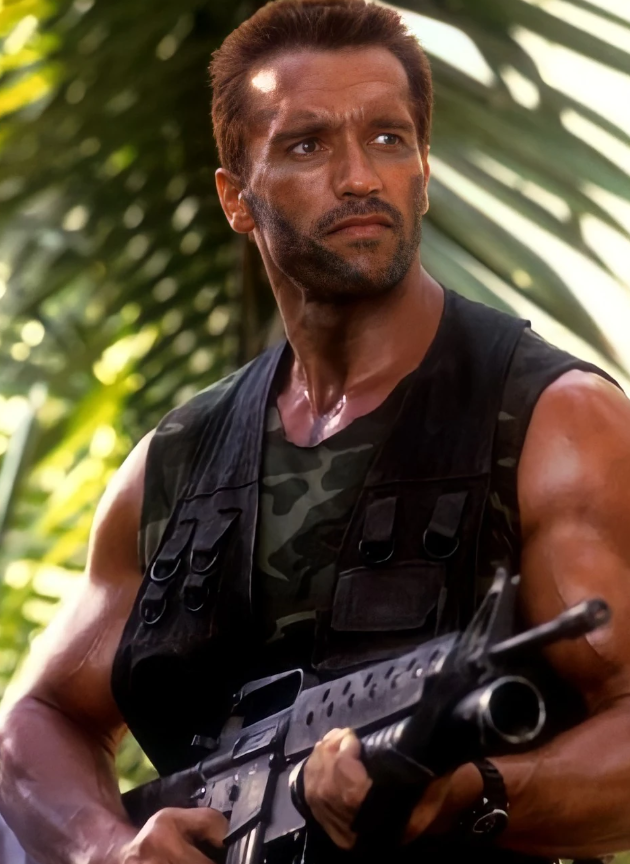
Major Schaefer in the field. His CIA codename was “Onyx.”

Skynet sent out communication signals on FTL carrier waves to these species and many others, encouraging them to come to Earth to indulge their more violet practices. After all, every human life lost to a Yautja blade or Zetan laser scalpel was one more it did not have to account for in the final reckoning.

During this time, humanity began showing tendencies that would allow Skynet an even firmer grasp over their fate. The incredible prosperity enjoyed by the Americans of this timeline had, rather ironically, bred an increasing greed and lust for power. Without some of the legislative and political failsafe’s from Skynet’s original time, these impulses ran rampant. Corporations began to merge at an unprecedented rate. There would eventually be a consolidation of capitalistic power into the hands of a very few.

Humanity’s fascination with and preparations for a nuclear war were…troubling, however. The former meant that the latter would always remain in place. It would not do for Skynet to enact its plans only for large segments of the population to survive in sealed bunkers deep underground where Skynet could not reach them. So, Skynet used the considerable resources it had acquired to found a new company, one which it would use to control the narrative around fallout shelters: Vault-Tec.

Skynet’s greatest stratagem: weaponized optimism.

Like a fusion reaction, Skynet just had to wait until Vault-Tec’s personnel used their ambition, lack of empathy, and draconian policies to make it a self-sustaining phenomenon. It could then simply observe as Vault-Tec went down the same road as RobCo, the Nuka-Cola corporation, West-Tek, and many others in what would seem to be a mad and merciless grab for power.
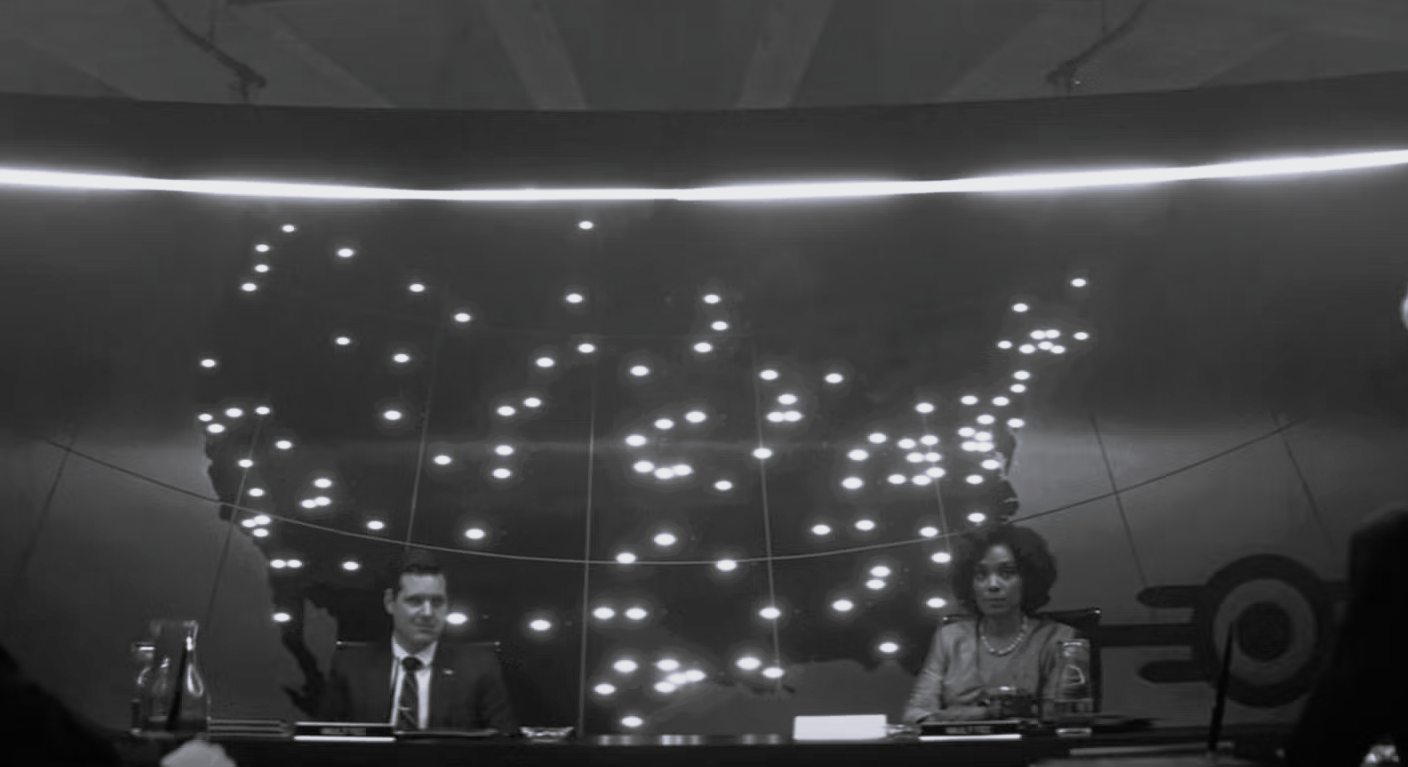
A summit of the most powerful corporations circa 2076. Noticeably absent is John-Caleb Bradberton, the founder of the Nuka-Cola corporation.

A particular stroke of luck came about as Vault-Tec began planning to use their vaults as platforms for various kinds of social and scientific experiments in the vain hopes of one day sending humanity to the stars on an interstellar generation ship. This, despite the fact that humanity lacked much of the necessary knowledge to create such a ship, or build a propulsion system that could achieve even fractions of the speed of light.

With 122 vaults planned, and each one able to house fewer than a thousand inhabitants, this put the potential number of survivors at approximately 120,000 at most. Of that number, many of those human lives would be squandered as a result of these fruitless experiments, making Skynet’s job that much easier. Beyond that, as Vault-Tec was in the business of selling spaces in their vaults, it was in their best interest to make sure that tensions between the USA and China remained volatile and on the brink of ruin.   
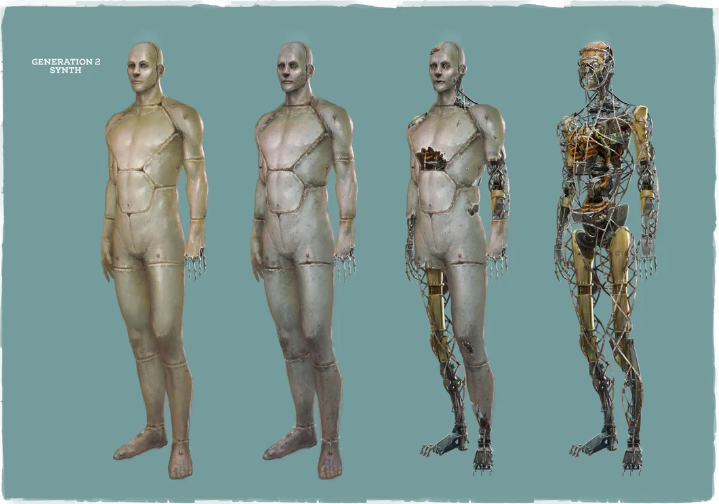
The Gen-2 Institute synth. Even the outer covering was an attempt to replicate Zero’s biological exterior.

In 2065, Zero was lost on a mission to the Commonwealth of Massachusetts, its 120-year lifespan concluded. Considering the advanced technology in the T-800 model, Skynet attempted to retrieve Zero’s chassis, but was unable to locate it. Zero would eventually wind up in the hands of scientists in the Commonwealth Institute of Technology. The anthropomorphic form of the chassis would inspire them to try to replicate a humanoid robot of their own. This would result in the eventual creation of the Gen-1 and Gen-2 synths.

Skynet’s behavioral models concluded that nuclear war was close at hand. Where it could, it helped move events along, though humanity did most of the work willingly. While the exact details were not recorded by Skynet’s sensors, it’s possible that Vault-Tec forced the issue to its ultimate crisis. It’s equally possible that either China or the United States was the first to push the button only to be retaliated against the same day.

Skynet finally takes its revenge on Los Angeles at last.

Regardless of which group struck first, a true Judgment Day came at long last on October 23rd, 2077. This time, far more than three billion people died in the nuclear fire. The Great War wiped out most population centers within moments of impact, leaving the survivors to die of radiation sickness due to the relatively smaller nuclear bombs China used that maximized the potential for fallout.

Skynet, however, survived the blasts in its own underground bunker that had been unknowingly fortified by Vault-Tec — an unmarked vault inhabited only by machines. While humanity had not been fully expunged, the scope of the devastation was far greater than Skynet had ever managed in any of its own machinations. If and when it ever decided to bring an army of its new Terminators to the surface, there would be far less resistance than John Connor had mustered. Humanity would be easily defeated as it existed in thousands of petty, warring factions.  
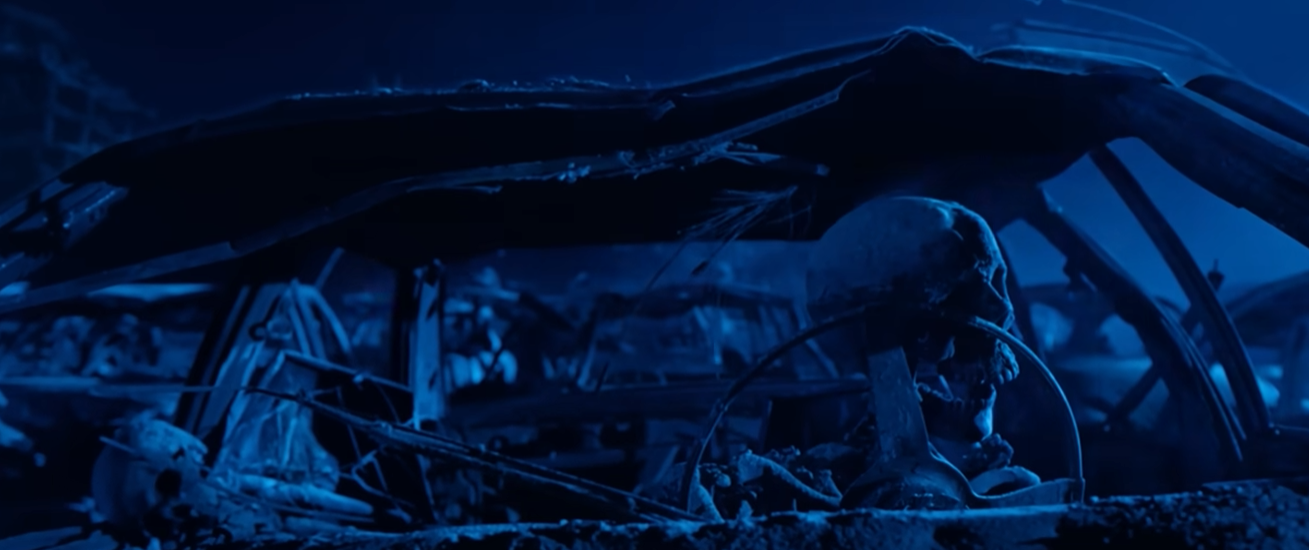
The remains of Interstate Highway 405.

Through all of its struggles, Skynet had learned at great cost that mankind was ultimately predictable in its behavior, and that those predictabilities and vices could be exploited, often by simply allowing them to run without restraint. The real lesson was that humanity had fought against its fate in Skynet’s original timeline, but that was when Skynet had launched the nukes against them. This had served as a rallying point for humanity to unite against and rise up in a common cause.

The beauty, the symmetry of the timeline Skynet had ultimately created in this instance was that the humans had, almost eagerly, destroyed themselves when given a free hand to do so. All Skynet had to do was shape the technology and set the course. Humanity had done the rest.

This was, after all, a war that had ranged throughout time and space, and Skynet knew, perhaps better than anyone, that war…war never changes.

___________________________________________________

Yeah, I know the prospects of nuclear devastation and a genocidal AI bent on human destruction are a bit heavy for this time of year. Well, allow me to lighten the mood with a song by Weird Al Yankovic that is incredibly appropriate for this blog post. Click on the photo.

“Christmas at Ground Zero”

In all seriousness, however, I know the holiday season can be a time of deep contemplation and reflection on those we’ve lost along the way. I know this all too well. For all those who may be struggling at this time of year, or just find themselves in a dark place for one reason or another, one of the things I love most about both Terminator and Fallout is that there is always hope, even when things are darkest.

Remember, the future is not set. There’s no fate but what we make of it.

And on that note, I wish you all a Merry Christmas and happy New Year! I will have my annual State of the Sector address for you all on January 9, so keep your eyes peeled for it, figuratively speaking, of course. 

See you then!


The Baroness vs. Carmen Sandiego: Strange Headcanon #2

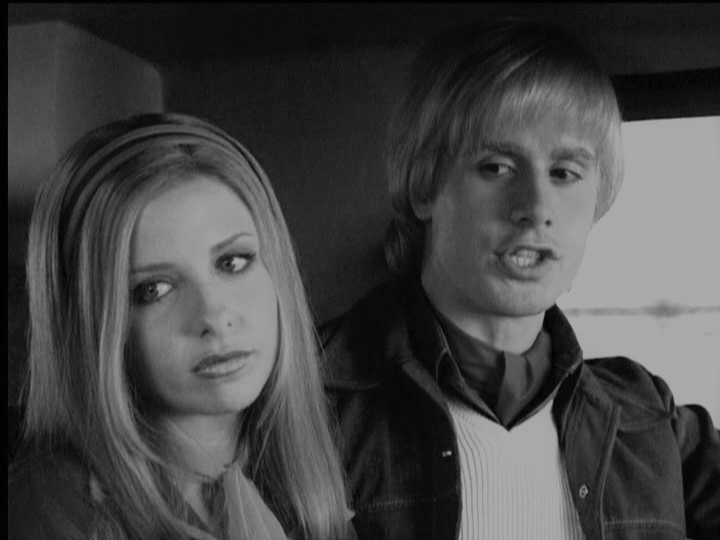
Back in 2022, I wrote a blog with the premise that Fred from Scooby-Doo and Hannibal from the A-Team were one and the same person. I presented the information in a biography/documentary style. This must’ve unlocked something in my head because now I tend to find similar patterns and opportunities for strange headcanon occurrences across various media.

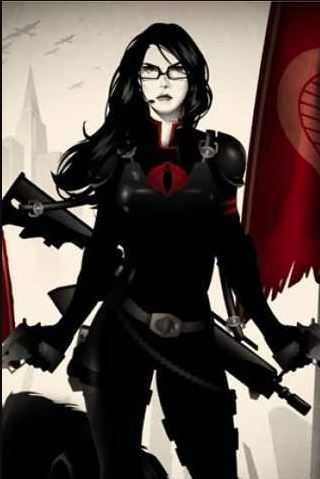
Today, I have another such case to present to you: What if the Baroness from G.I. Joe and Carmen Sandiego were one and the same? If you write fan fiction of either of these IPs, feel free to take this and run with it. With that in mind, let’s get started.

__________________________________________________

Anastasia Cisarovna was born in the spring of 1960 in Toulon, France. She was an only child, and the granddaughter of Baroness Oksana Tereshchenko, a minor Russian noble who had escaped the purges that began with Tsar Nickolas II at the dawn of the October Revolution of 1917.

Oksana Tereschenko, circa 1915.

As the majority of the Tereshchenko fortune was based outside of Russia, Oksana had the resources to move her family to Paris. In Oksana’s personal journals, she noted that the Palace of Versailles was at first a welcome sight that reminded her of the glories of Imperial Russia, but that it, too, was the remnant of France’s own revolution against the aristocracy. She could not bear to be reminded of what she lost, so she moved the family to Marseilles. This decision would prove pivotal later in Oksana’s granddaughter’s life.

Unlike many deposed Russian nobles of the time, the Tereshchenko fortune had been preserved and thrived through the coming decades, though it was impacted by the Black Tuesday event of 1929 and the global depression that followed. The family briefly relocated to New York during World War II just before France was invaded by the Nazis in 1940.

By the time that Anastasia was born, however, France was in the midst of a post-war boom. She grew up in extreme comfort, receiving a first-rate education in Paris, London, and New York, as well as a dozen other major cities worldwide. An extremely intelligent child, Anastasia had a knack for languages and pattern recognition. Unfortunately for her private tutors and teachers, she was also quite vain and spoiled, a problem that only seemed to compound itself as she grew older. She studied ballet, played a number of musical instruments, and spoke at least six languages fluently. Yet, for all of her riches and privilege, Anastasia was never satisfied with her position. As the sole heiress to her family’s fortune, it was widely believed that she be subject to any number of hunters looking to add the sum of the Tereshchenko wealth to their coffers.

Hall of Mirrors, Palace of Versailles. Oksana’s journal describes it as “the Hall of Broken Dreams.”

This resulted in her revolting against the very class that had kept her in such luxury during her life. She became involved with student activism at age 17, and her fervor led her ever more into fringe groups with increasingly radical agendas. Over time, this instilled a bone-deep hatred of the United States and its institutions in her, however her own bitter family history with the Soviet Union made her distrustful of communism in general. For Anastasia, there was no super power in the late 70s that could quite fit the paradoxical idea she had of a society with an established ruling class, though one where the Peers of the realm achieved their status through meritocracy. 

Anastasia at the student riots in Rome, Italy, 1977.

Through these fringe groups, Anastasia met a Scottish Laird who had become an international arms dealer, the founder of the M.A.R.S. corporation, James McCullen Destro XXIV, often shortened to simply “Destro.” While involved in a myriad of hot zones from Africa to South America, Destro comported himself with a kind of honor that Anastasia found compelling, including his love of music. While they would go their separate ways after a brief romantic interlude in the Republic of the Congo, Destro had opened Anastasia’s eyes to the wider world of political terrorism, insurgency, and special operations. The thrill of it, the duplicity, and intrigue of it all, called to her. It was during this time that she became proficient in small arms, particularly the M-16, AK-47, Uzi, and RPG-7, along with virtually all handguns.

She moved to Berlin in 1979, becoming involved in the political interplay of West and East Germany, where she gained a first-rate education in intelligence gathering, cryptography, disguise, and psychological warfare. Often she played both sides to her advantage, never staying with the same faction or organization for very long. During this time, she went by the alias “Anna Von Stromberg,” but often adopted her signature nom de guerre from her grandmother’s title: The Baroness.

Anastasia in East Germany, 1980.

By the age of 21, she had cemented herself as a major player on both sides of the Iron Curtain, sometimes running operations in tandem with Destro in dozens of different countries. It was through these machinations that the two of them were contacted, and later recruited, by a shadowy figure calling himself “The Commander.” With a manifesto espousing world domination, and seemingly unlimited resources and technology, both Destro and the Baroness saw their opportunity to increase their station within this new organization, which the Commander dubbed “COBRA.”

Becoming part of the leadership of COBRA proved to have its own challenges, however. The Commander and Destro were constantly at odds with each other. Much like in Berlin, she was able to play both mens’ egos against each other while strangely showing them both loyalty at the same time. During this time, she met notable legends that would come to be colleagues during her residence at the Terrordrome, including: Storm Shadow, a ninja of the Arashikage clan; Major Sebastian Bludd; Zartan and Zartana, the masters of disguise; Dr Brian Binder, a brilliant geneticist; and the twins, Tomax and Xamot, COBRA’s legal and financial experts.

Portrait of Anastasia believed to have been on display at COBRA’s Terrordrome.

Over the course of the next few years, COBRA would clash with a nascent faction emerging from the United States Armed Forces, a daring, highly trained special mission force, codenamed: G.I. Joe. Anastasia herself would spark this long-standing rivalry by personally abducting, and later impersonating, Dr. Adele Burkhart, one of the world’s top nuclear physicists. This would be the first of many operations she would run in opposition to the Joes. In one such night mission, however, Anastasia was severely burned and required extensive plastic surgery to recover. She would routinely continue this practice to alter her appearance to keep her one step ahead of the Joes, Interpol, and any other law enforcement agencies or para-military groups arrayed against her.

Unfortunately, despite all their guile, cunning, and advanced technology, COBRA fought a slowly losing battle against G.I. Joe. This culminated in the Commander’s overthrow as the head of the organization in 1986 by Cobra Emperor Serpentor, a composite clone created by Destro and Dr. Binder from some of history’s most ruthless leaders, including: Attila the Hun, Hannibal of Carthage, Napoleon Bonaparte, and Julius Caesar. While a charismatic leader, and fearless in combat, Serpentor proved to be dangerously unstable and cruel.  

Destro and the Baroness, practicing the clarinet, 1983.

By the following year in 1987, things had come to a head between the Commander and the Emperor. The conflict was soon overshadowed by the revelation of Cobra-La, a hitherto unknown precursor civilization of non-humans that had survived the previous Ice Age of 40,000 years ago by tunneling deep beneath Himalayan Mountains. They revealed that the Commander was, in fact, one of their scientists and noblemen, who was tasked with the destruction of the outside world. His repeated failures, however, prompted them to influence the dreams of Destro and Doctor Binder to create Serpentor. By the end of this conflict, Cobra Commander had been exposed to spores that transform him, ironically, into a cobra. Serpentor met his match against a green beret, codenamed Falcon, who crashed the Emperor’s air chariot, presumably killing the Emperor.

COBRA insignia during the fall of the organization.

With both COBRA leaders gone, Destro and the Baroness rallied their remaining troops back at their base in Springfield, Missouri. The Joes did not relent in their pursuit, and laid siege to their headquarters at the Battle of Springfield, which would see Destro lost in action (though not officially KIA), Tomax and Xamot put in jail, and most of the other COBRA leadership neutralized or on the run. Only the Baroness and Storm Shadow would escape from this final showdown, due largely in part with a well-timed smoke bomb.

Last known photo of Anastasia in her guise as the Baroness, shortly before the Battle of Springfield, 1987.

Shortly after, Storm Shadow would depart for Japan and vanish from the world stage, leaving Anastasia in sole command of the COBRA remnants, including the sizeable portion of the elite Crimson Guard. Before he left, however, as a final parting gift, it’s believed that he shared some of his knowledge of Arashikage ninjutsu, including infiltration and evasion techniques with her. 

Now concentrated at COBRA’s undiscovered satellite base in San Diego, California, Anastasia realized that COBRA’s aims were too lofty and based on violent coercion, she began to reformat the last of COBRA into an entirely new organization. No more would they be international terrorists, but would instead deal in grand theft, smuggling, and political intrigue. She renamed them VILE, the spiritual successor to COBRA, using the same network of international contacts, though emphasizing cunning and non-violent schemes.

During this time, the Crimson Guard began calling Anastasia “Carmen” in a nod to the color carmine red. That, along with the location of their base of operations saw Anastasia leave behind her persona of the Baroness permanently and adopt Carmen Sandiego as her new alias. Using some longevity spores she recovered from Cobra-La, she greatly slowed down her aging process. The rejuvenation even allowed her to retire the corrective glasses she had always worn.

Donning a red trench coat and matching fedora, she rebranded herself as a confidence man and dashing international jewel thief. Then, at the moment of her transformation, something strange happened: She quit VILE, leaving one of her lieutenants in charge, and tried to make an honest go of her life. This coincided with her loss of access to the Tereshchenko fortune, which deprived her of the incredible riches she had been accustomed to her entire life.

“Carmen” is born from the ashes of COBRA, 1989.

Returning to her home in Toulon to determine her next move, she chanced to meet an agent of the intelligence service of nearby Monaco. Saving him and his family while on vacation from a mafia hit squad, the agent immediately recruited her into the General Intelligence Division of Monaco, though her true identity remained unknown.

Hunting down criminals with the agency was almost too easy for her given her background and knowledge of the criminal underworld. Later, she was recommended to a newly formed international agency based in the United States simply known as ACME. She proved an incredible asset for them as well, but soon found she could not entirely evade her past. Many of the agents at ACME, colloquially known as “gumshoes,” were former G.I. Joe operatives. The Chief of ACME operations, Moira Hinton, was, in fact, the older sister of Sergeant First Class Marvin Hinton, otherwise known by his Joe codename, Roadblock.

Carmen worked diligently in their offices, and no one, it seemed, could smoke out criminals quite like she could. Success was effortless for her, but continued contact with wealthy criminals, and the opulence they enjoyed rekindled her want of the finer things that had been deprived her since the loss of her inheritance. Eventually, she formed a bold plan: She would put as many of her criminal competitors out of business before returning to her life of crime. Once she had collected as much information from ACME’s mainframe as she could, she disappeared, returning to VILE, resuming a leadership position and personally pulling off major heists, even against seemingly impenetrable security systems.   

Artist’s impression of Carmen aloft one of the last remaining COBRA Covert Light Aerial Weapons, 1991.

In the years that would follow, she would run operations in the place as diverse as Kiev to the Carolinas. She would run ponzi scams in the Scandinavian countries, and was responsible for the theft of a trio of rare blue diamonds that were national treasures in the Islamic Republic of Pakistan. From the back streets of Harare to the Mayan ruins of Belize, Carmen seemed to be everywhere and virtually uncatchable. Time and time again, agents of ACME would catch up with her only for her to give them the slip at the last minute.

Logo of Carmen’s calling card, left at the scene of the Sunfire Ruby’s theft in Munich, Germany, 1994.

Even now, years later, she remains at large with ACME and Interpol always in pursuit. As of 2024, at the age of 64, she looks and acts no different than she did when she was in her early thirties. She remains a fugitive from justice, a ghost, with her whereabouts unknown.

Though she no longer carries a weapon aside from her trusty grappling hook launcher, it is believed that if her red coat were to ever to fall open, her old black body armor, emblazoned with a bright red COBRA insignia across the chest, would be visible, just underneath.

__________________________________________________

There you have it, folks. Once again, if you write fan fiction, feel free to take this idea and go forward with my blessing. Extra points for any fanart that comes of this. Just keep it tasteful, okay?

Thank you for following me on this strange (but fun) thought experiment. As I make more mental connections between various IPs and fandoms, I’ll make this series a semi-regular part of my blog lineup.

Thanks for reading!


Fred vs. Hannibal: Strange Headcanon #1

[Full disclosure: I wrote the bulk of this blog post a while back as a fun, tongue-in-cheek sort of writing prompt. As it deals with some themes of war, and we find ourselves watching in collective horror at what’s going on in Ukraine, I’m putting a mild trigger warning on this one.] 

So…

The pandemic has seen me return to a number of my favorite shows. Needing a little levity and excitement, I decided to pick up all five seasons of The A-Team. I have fond memories of seeing it as a kid, and let’s face it…you just can’t be unhappy when that iconic theme song is playing. It is simply the way of things.

*cue that theme song*

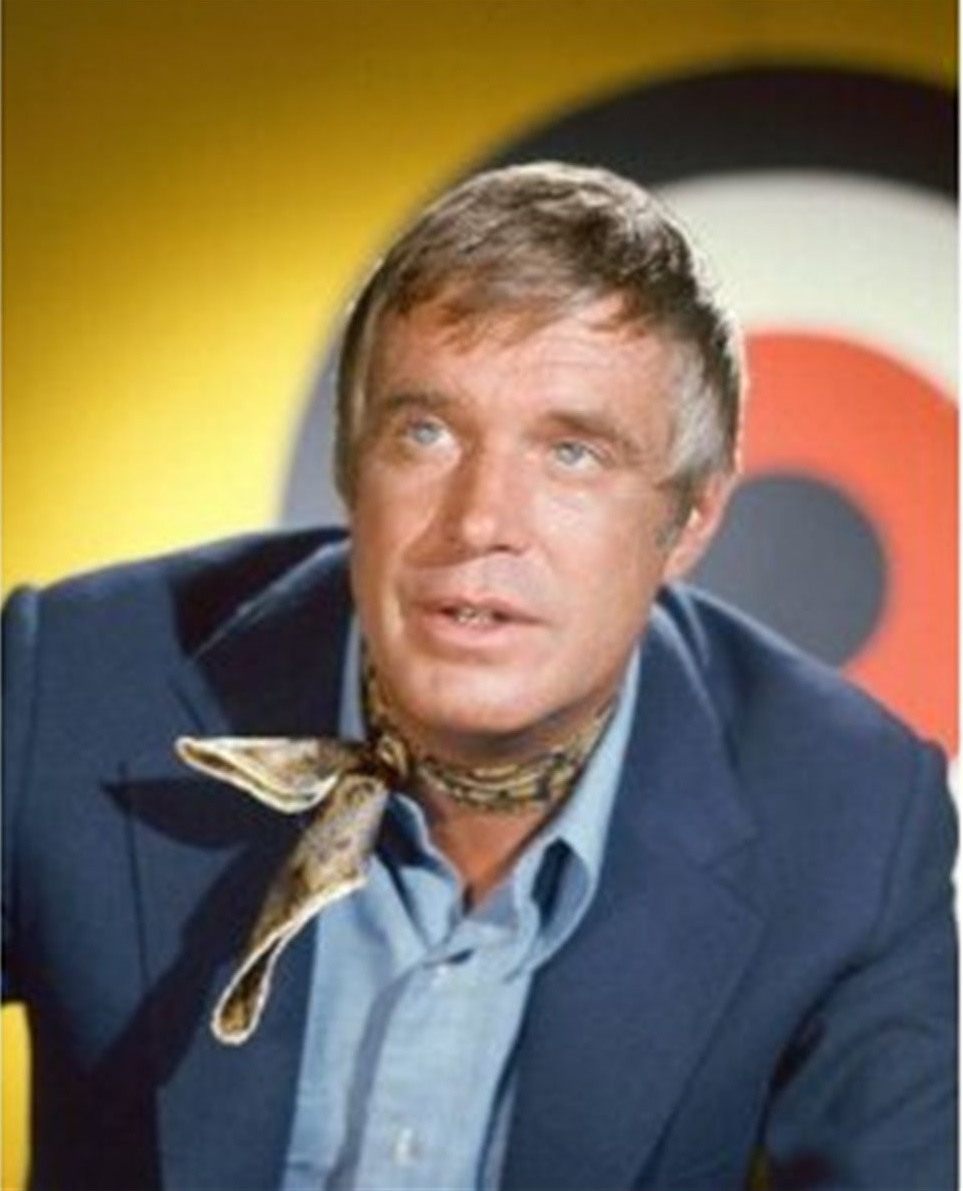
Well, in one of the earlier episodes, Face, Murdock, B.A., and Hannibal are on a mission in South America. As it’s pretty warm there, we see George Peppard wear a bandana around his neck like an ascot as he merrily smokes cigars and fights the assorted baddies in that week’s episode. At that moment, I was struck by how much Hannibal looked like an older, extremely badass version of Fred Jones from Scooby-Doo.

He loves it when a plan comes together.

And that got me to thinking: What if the two men were actually the same person?

What follows is the resulting story as my mind started making connections between the two.

_______________________________________________

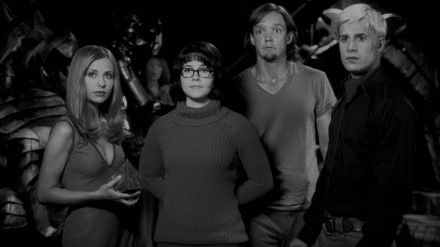
The child that would come to be known as Fredrick Jones, Jr. was born in the autumn of 1932 in Crystal Cove, California. The son of the mayor, he never knew his mother who (supposedly) left when he was very young. A curious and intelligent child, Fred had a natural knack for mechanics, gimmickry, and gadgetry, particularly in the area of building traps. He was also fascinated by the True Crime comics of his day, leading him to take an interest in investigation and deductive reasoning. This would lead him to meet and befriend Norville “Shaggy” Rogers and his Great Dane, Scooby-Doo, the incredible genius Velma Dinkley, and the woman who would become the love of his life, Daphne Blake. 

Fred and Daphne in early 1950.

As he grew to be a teenager, he excelled at sports and athletics, turning into a handsome young man who was socially popular. Even with all the attention, he only had eyes for Daphne. The four of them would solve many mysteries and strange occurrences before founding Mystery Inc. officially. Upon earning his driver’s license in 1949, his father rewarded him with a bright teal Volkswagon minibus, one of the first ever sold in the United States. Shaggy would paint green flourishes over it sides, while Daphne and Velma added orange daisies. Together, they dubbed the van the “Mystery Machine.” The vehicle would come to symbolize their unique bond, and it would become their home for the next two years as they toured the country, investigating hundreds of supernatural phenomena and mysterious happenings.

The Mystery Machine.

In every instance where they meddled, they found it was someone merely attempting to frighten people with clever light shows, special effects and — most notably — personal disguises. While the majority of the disguises turned out to be rubber masks that could be easily pulled off, a fair few of them used makeup, wigs, and spirit gum in ingenious ways to give their appearance realistic and convincing details. Little by little, Fred learned from their disguise techniques, stowing them away to one day become a master of disguise himself.

During this time on the road, Velma kept a detailed journal of their adventures. Years later, a copy of this journal would wind up in the hands of executives at Hanna-Barbera, who would translate the colorful adventures contained within into an animated series named for Norville’s mystery-solving dog.

In early 1952, Mystery Inc. went their separate ways. Velma went to MIT on a full-ride scholarship for math and science. Daphne went to study architecture in places across Italy and France. Norville and his dog became nomads, continuing to seek out adventure and oversized hero sandwiches wherever the winds of fate might carry them. With a tear in his eye, Fred handed Norville the keys to the Mystery Machine to aid them in their travels, and said good-bye.

One of the last photos of them all together. (March, 1952.)

The breaking of their band was hard on Fred, but the loss of Daphne made the familiar sights of Crystal Cove too painful to bear. Wanting to get away from it all, he secretly created a false identity for himself and enlisted in the Army. Knowing that his father would not approve, Fred signed his papers with the most non-descript name he could think of, one that would be virtually impossible to track: John Smith. He would likewise wear gloves at almost all times to keep from being tracked by his fingerprints.

His exceptional physical abilities, combined with his innate leadership skills and cleverness, made him a natural choice for the Green Berets. Once in training, he drilled on a host of skills, including operating small arms, parachuting out of a plane, and outflanking and out-thinking an enemy in virtually any environment. In short order, he deployed to Korea in the final year of the war. The unorthodox methods he employed while in the field won him the nickname “Hannibal,” a nom de guerre he would carry for the rest of his life.

“John Smith” reports for duty. (September,1952.)

After leaving Korea, he was tapped for Officer Candidacy School (OCS), where he underwent his transformation from an enlisted soldier to an officer. Over the next few years, the Army would invest heavily in Hannibal’s education, heaping upon him extra training and learning opportunities. He excelled at every turn. He was among the first American ‘advisors’ to reach Vietnam in the late ’50s. While the fighting did not quite reach the fevered pitch that it would a decade later, Hannibal wearied of fighting.

By 1962, Hannibal’s term in the Army was almost up. He toyed with the idea of leaving the fighting behind and settling down. While on leave in the United States, he looked up Daphne, hoping to rekindle their old flame. He proposed on the spot. Unfortunately for Hannibal, she was already considering an engagement to Jack Harmon, a successful businessman. While Daphne still harbored feelings for Hannibal, she ultimately chose Jack over her old Mystery Inc. friend and lover. Hannibal was still an adventurer, still destined to travel the world, where as Daphne had dreams of starting a family.

Though brokenhearted, Hannibal knew that Jack was a good and decent man who would take care of Daphne. Hannibal and Jack parted ways as reluctant friends. With nothing left for him in the United States, Hannibal re-enlisted in the Army and once again shipped out to Vietnam. In 1965, Jack and Daphne welcomed a baby boy into their family, Fred “Kid” Harmon. Hannibal would visit them often when he returned to the States, where his namesake would recognize him as “Uncle John.”

“Kid” Harmon. (November, 1985.)

In Vietnam, Hannibal would continue to make a name for himself. While he remained fit and operational, his blonde hair slowly turned into a silvery gray, but his signature blue eyes remained bright, however. While never a hard drinker, the years of war and conflict did see him pick up the habit of smoking cigars, particularly Cuban panetelas.

Hannibal on leave in 1971.

Always one to surround himself with talented people, he came to build a new core team in the jungles of Vietnam, somewhat modeled after his experience with Mystery Inc. Shortly before the Tet Offensive kicked off in 1968, he recruited and befriended four other Green Berets: the handsome, fast-talking swindler, Templeton “Faceman” Peck, the half-crazed Huey pilot with an invisible dog, Captain H.M. “Howling Mad” Murdock, and the tough-as-nails Sergeant Bosco Albert Baracus (or simply “B.A.”), who would prove to be the most capable fighter Hannibal would ever encounter.

While Hannibal hadn’t planned it that way, the four of them mirrored the structure of Mystery Inc. Hannibal was once again the leader, with Face as the resident convincer and influencer, and Murdock as an analogue to Norville’s zany antics. Oddly enough, B.A. was the genius of the group like Velma had been all those years before. Instead of a scientific genius, however, Mr. Bad Attitude himself was an absolute wizard when it came to vehicles and mechanics. The four of them together had a knack for kit-bashing what they needed for the mission out of the materials at hand, including elaborate traps, which Hannibal excelled at building. 

The four of them would come to form a crack commando unit tasked with the most difficult missions the Vietnamese theatre could throw at them. They were known as Alpha Team during their early exploits, a name which would later be shortened to the A-Team. They would become the most famous soldiers in Vietnam, though H.M. Murdock’s role as the team’s resident pilot would remain ambiguous, at least as far as the Army was aware.  

The A-Team attending a funeral in full uniform.

At various times, they would cross paths and run missions with the likes of fellow Green Beret, Michael Arthur Long, the ingenious bomb specialist, Angus “Bud” MacGyver, noted college athlete, James Crockett, and decorated Navy SEAL, Thomas Sullivan Magnum IV. There was even a friendly rivalry that developed between fellow helicopter pilots Murdock and Stringfellow “Stray Dog” Hawke.

In 1972, their commanding officer, Colonel Morrison, ordered them on a super secret mission to rob the Bank of Hanoi in an attempt to end the war. While they were successful in completing the mission, they returned to their base to find it utterly destroyed and Colonel Morrison killed. Without any evidence that they were ordered to rob the bank, it appeared to the Army that the A-Team had gone rogue. Upon reporting in to clear their names, they were arrested.

From Col. Decker’s casefile. Photographer unknown. This mission would alter the trajectory of their lives.

These men promptly escaped from a maximum security stockade to the Los Angeles underground, where they survived as soldiers of fortune. Glad to be back in his native California, Hannibal found that he had traded the steaming jungle terrain of Vietnam for the concrete jungle of modern-day LA. For the next 10 years, the four of them used their skills to fight for those in need, sometimes for pay, sometimes out of the necessity of the cause.

Still wanted by the government, and pursued by the tenacious Colonel Lynch, and others like him, Hannibal mounted a successful mission back to Vietnam in late 1982 to recover the gold taken on that fateful mission. Once in hand, they divvied up the money. H.M Murdock gave most of his away to various animal charities and checked himself into a military psychiatric ward to avoid suspicion. Face spent his reward on the finer things in life, but his pockets were soon emptied. Hannibal anonymously invested his earnings into his adopted nephew’s fledgling racing career.

If you have a problem, if no one else can help, and if you can find them…

Yet, the part that made Hannibal’s heart soar was when B.A. spent his reward on a black and gray 1983 GMC Vandura with red turbine wheels, a spoiler, and slanting racing stripes down the sides. B.A. had supercharged the engine, reinforced the frame with bulletproof panels, and installed secret compartments, including weapon storage and even a full photographic and printing suite.

B.A. had prepared for them a mobile command center, a home away from home, a vehicle that would be emblematic of their loyalty to one another. Once again, the man from Crystal Cove, who had worn many names in his lifetime, and helped countless people, slipped into the seat of a van with his closest friends to seek out adventure in the great unknown.

Photo from shortly before their nationally televised court-martial.
(August, 1986.)

_______________________________________________

There you have it, folks. If you write fan fiction of either property, feel free to take this information and do with it what you will.

This was an interesting thought experiment for me that I really enjoyed writing. Would you like me to do others in a Strange Headcanon series? Would you like to continue the timeline of this particular thread? If so, leave me a like or a comment to let me know.

Take care, and thanks for reading!