Richard Hatch passed away last week, and it got me to thinking. Most folks probably remember him as Captain Apollo, starring beside Dirk Benedict and Lorne Greene in the original Battlestar Galactica. My favorite role of his was in Galactica, but not in that one. I’m talking about his role in the 2004 reboot as the calculating political operator, Tom Zarek.
Previously, on Battlestar Galactica…
While lamenting Mr. Hatch’s passing, I found myself revisiting the music of both the original and reimagined series. Of course, I still feel the thrill and majesty of the original main theme. As a connoisseur of space operas, that one is pretty boss. Inevitably, I began listening through the score of the ‘new’ series, which is tonally much darker and angst-ridden (pretty much like the show itself).
For the most part, I don’t look back on New Galactica very fondly, mainly due to the nonsensical third and fourth seasons, and the X-files/LOST kind of ending that was disappointing in the extreme. But then I rediscovered the track “Reuniting the Fleet.” Go ahead, give it a listen. I’ll wait.
The same mix of drums and the uilleann pipes are a direct callback to an earlier piece of music, “A Good Lighter.” Both instantly transported me back to my favorite moments in New Galactica. One is where Adama, played by Edward James Olmos, shared a moment with his son, Apollo, (Jaime Bamber) on the flight deck before an all-important mission. While I take issue with the direction of the show, the peformances remain incredible, and this scene between them – just thinking about it as I write this – gives me a big ol’ lump in my throat.

I’m not crying. You’re crying!
The same is true for the “Reuniting the Fleet.” Faced with leaving the colonists behind on New Caprica in search of Earth, Adama makes the decision to reunite his people, who were sharply divided down ideological and political lines. I remember watching that scene on TV and being moved by it. Now, it’s downright profound.
With this level of emotion, atmosphere, and acting, how could my immediate impression of the show be negative, now after nearly eight years since it went off the air?
There are so few shows that leave me with such mixed emotions. The aforementioned X-files and LOST are two of them, certainly. These are shows that I absolutely loved at the beginning, but by the end watching an episode was uncomfortable, and largely consumed out of ‘fan duty’ if that makes any sense. And also the hope that it would get better.

*holding in the existential dread* It’s going to get better…right?
When I first discovered New Galactica, I feel in love. Unlike many old-school Galactica fans I know, I really loved the darker more helpless tone of the new show. It really felt like a great tragedy had befallen the survivors of the Fall of the Twelve Colonies, and this had scarred them all to a lesser or greater extent. Here was military science fiction I could really sink my proverbial teeth into.
The first and second seasons of New Galactica, as well as the first few episodes of season three were not only some of the best sci-fi I’d ever seen on TV, but also one of the best dramas. Full stop. Again, I cannot say enough good things about the performances turned in by Olmos, Callis, Sackhoff and so many others. Bear McCreary’s score put it over the top. The discovery of Kobol and the hint that old gods where not who they seemed, the return of the Pegasus, and the interplay between Adama and Cain…wow. Intense. Like Samuel L. Jackson in the diner with Tim Roth in Pulp Fiction.
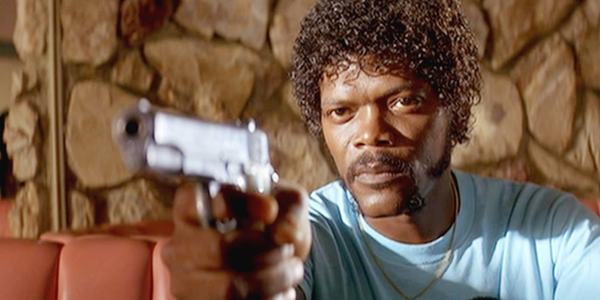
Yeah, pretty much like that.
But once our intrepid heroes blasted their way off of New Caprica, season three took an immediate nosedive. They had gotten the show back on the road, back on the quest for Earth, but it seemed like the writers and showrunners had less of an idea of what to do next. The intro to the show boasted of the Cylons that ‘they have a plan,’ but it became apparent that the showrunners didn’t.
Season three felt like this strange mix of individual character studies that didn’t seem to support what had gone before. Previous to this, each episode had stacked on top of the last, adding layers to the story while adding new developments, new wrinkles. These new episodes, however, felt like you could pull them out of the pile and they wouldn’t be missed. In fact, ‘Hero’ was an episode that I think weakened the series as a whole.
The continuity began to unravel and characters began acting, well, inconsistent to say the least. Adama is willing to stand Cally up against a bulkhead and execute her if Chief Tyrol doesn’t comply to his demands because ‘he can’t have people deciding when to obey orders,’ but does nothing to Helo for disobeying orders when they could have shown Hugh the insidious diagram and destroyed the Borg Collective…er—I mean the Cylons, and saved the human race. And then Helo is promoted to CAG, even after this incident…and he’s not even a pilot.

Baltar isn’t so sure about that. Baltar is not alone.
There were some bright spots along the way, to be sure. I’m a huge fan of Jane Espenson, and so the middle of the season got a bump with “The Passage” and “The Eye of Jupiter.” But then the ‘All Along The Watchtower’ moment happens at the end of season three that really looked like the show had gone off the rails, and I wasn’t sure it was coming back.
It took more than a year, but come back it did. There was a little improvement, but that’s when the ‘Final Five’ story arc came into play, and for me…the worst thing about the show, not counting the ending. I was this close to just calling it and watching something else. It takes a lot for this fanboy to want to pack up and go home, but I was done.
Then we got to the mutiny arc and, by Grapthar’s Hammer, we were back, baby! The excitement, the drama, the everything…I wanted to shout at the producers: “This is what I’m talking about! Every episode should be like this!”
But after that, the show went back to floundering. They found ‘Earth’ only it wasn’t Earth, and we got a pretty weak explanation of how the Twelve Models came to be, even though it didn’t make much sense AND seemed to contradict what we knew about them already. Again, I must stress, Final Five = Worst Part of the Show. Somebody should have really gamed this out ahead of time. I understand writing yourself into a corner, but come on.

Submitted for your approval…
By this time we all knew that Season Four would be New Galactica’s last. You couldn’t tell it by the way the story plodded on, however. The episode “Someone to Watch Over Me” did not feel like a series with only a few episodes left, but rather a series that still had three or four seasons still to come.
And the ending? Well, let’s just say that it would take the god-awful ending of LOST to eclipse New Galactica on my ‘Worst Ever’ list. It still remains in a solid #2 spot, however. From eschewing technology for no good reason, to Kara’s unexplained departure, and even Adama deciding to live alone for the rest of his life rather than with his son, there are so many horrid things here that a recounting of them all would be a blog post unto itself. It had some interesting action sequences, and *something* of a resolution to the ‘All Along the Watchtower’ craziness of before, but…well, yuck. Not with a bang, but a whimper.
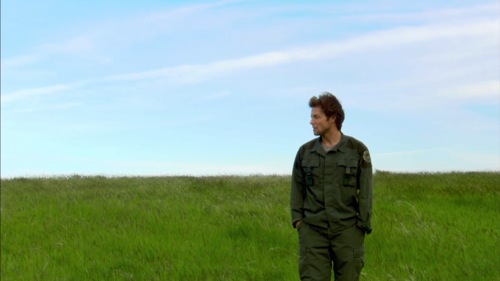
Yeah, Brah, I don’t know what to make of that either.
So why do I bring this up? Is it just to bash a long-time fanboy disappointment? A bit, yeah. But really it’s to show the extreme ends of the pendulum here, and the lasting impression it made on me both coming and going.
Understand that I still use Bear McCreary’s music when I write. (If you ever need to write an epic combat scene, put “Prelude to War” on your playlist, trust me.) I follow the projects of cast members of this show as much as I do for Firefly, or Babylon 5, or Star Trek. I love to see cosplay of these characters, and enjoy fan theories on the connections between the original series and the new.
That’s still with me.
This show meant something to me. It still does to some degree. I only wish that more care and energy had been put into the latter half of the series to match the first. To me, New Galactica serves as both a shining example and a cautionary tale of what to do/not do in modern science fiction.
Like with people, you have to take the good with the bad here. And in that sense, boy howdy is New Galactica like the contradictory nature of the deeply flawed people it portrayed in the show.
Can I get a “So Say We All”?
__________________________________________________
Do me a favor, okay? Subscribe to my newsletter for more news, updates, and information on Sector M’s current and upcoming projects!








 The Sector M