Tag Archives: Science fiction

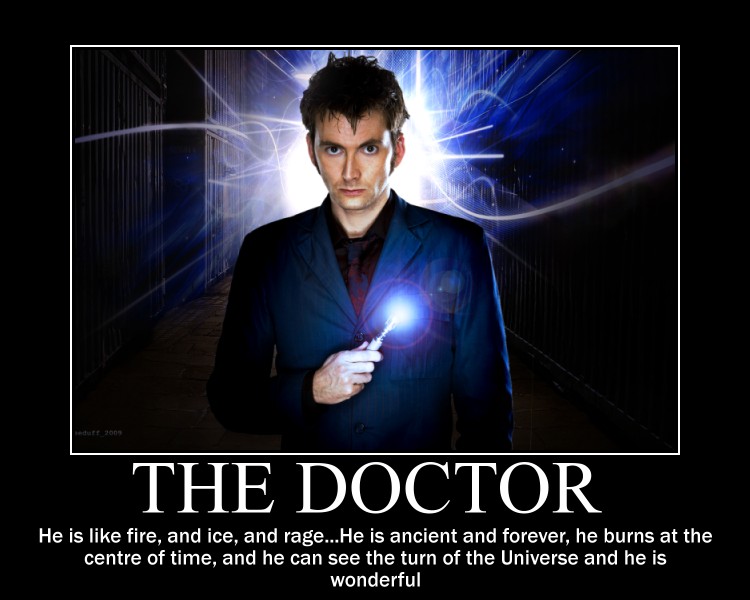
Why I Love The Doctor

I’ve heard it said that being a geek means never having to say you’re sorry for loving something. Good thing, because this blog post is all about why I love the Doctor in Doctor Who.  If you’re a Whovian already, this post is likely just shooting fish in a barrel, but I will tell you why I love the show and the character of the Doctor in particular.

For those of you who are not necessarily fans of the show, here is a peek into that particular fandom.  It’s true that Whovians occupy a strange niche of the overall sci-fi genre. You can see them at conventions with their scarves, long coats or bow-ties, often waving around sonic screwdrivers with every photo-op.  Or maybe it’s just a T-shirt with a blue box on it or the words “Don’t Blink.”

Regardless of what they look like, these folks are linked together by a single television series that first debuted in 1963. The central character of that show is the Doctor (BTW, his last name is NOT ‘Who’), and is one of the most compelling and enduring characters in all of science fiction. Here’s why I love him:

50 Years Creates a Legend

doctor_who_50th_anniversary_tardis_logo_by_thedoctorwho2-d61qmle

Yeah, baby, yeah!

This year marks the 50th anniversary of the show.  With more than 200 episodes in its continuity, not to mention novels, video games, comics and radio plays, the Doctor has been on a lot of adventures. This gives him a body of past accomplishments that practically dwarfs any other sci-fi character. Doctor Who is, after all, the longest running sci-fi TV show of all time.

Even in the current series, there are references and throwbacks to things which happened at the very beginning of the series.  By this point in the storyline, the Doctor has achieved a nearly unrivalled heroic status. I mean, if you can boast that you’ve saved the Universe or the Earth more times than Kirk or Picard, and possibly as many times as Superman, I’d say you have some bragging rights.

His Heart (Both of Them)

large

With all my heart.

The Doctor has lived over 900 years.  He’s fought evil forces and saved quadrillions of innocent lives. While some of his travels can be lighthearted, there are times when the Doctor is deadly serious, and must champion existence itself.  It is the force of his convictions and his almost unimaginable capacity for compassion and mercy that drive him. There are so many times in the series where he could have chosen the easy path and just walked away.  But he doesn’t.

The Doctor stands and fights, most of the time without weapons, and with only the help of his trusty sonic screwdriver and the companions at his side.  Yet, when the smoke clears, the Doctor is triumphant even against the most impossible odds. While he can’t always save everyone around him (the body count in Doctor Who can get pretty high), the Doctor finds a way − always.  He never runs out of hope. His hearts, much like his beloved TARDIS, have to be bigger on the inside, like a super-reversed Grinch.

His Mind Is His Greatest Weapon

Doctor+Who+3+I+love+that+you+add+the+Tardis+_45f1909bfa5f8247ca7bfb4fafbd0b2e

What he said.

Perhaps the thing I love about this character the most is that his mind is the most awesome weapon in his arsenal.  The Doctor is almost always able to outthink and outmaneuver his enemies, even if they initially get the drop on him. He has that uncanny knack for using the opposition’s strength against them.  So, the greater the force arrayed against him, the more dangerous he becomes.

In an age of brute-force action heroes, who are more concerned with kicking down doors and mowing down anything that moves, the Doctor presents us with a daring and compelling alternative.  He uses violence as a last resort, rather than leading with it. I think that this peace-loving mindset makes the storylines in Doctor Who that much more interesting and rich. (And this is coming from a guy who writes military science fiction!)

An Unbroken String of Great Performances

doctor_who_50_years_large_verge_medium_landscape

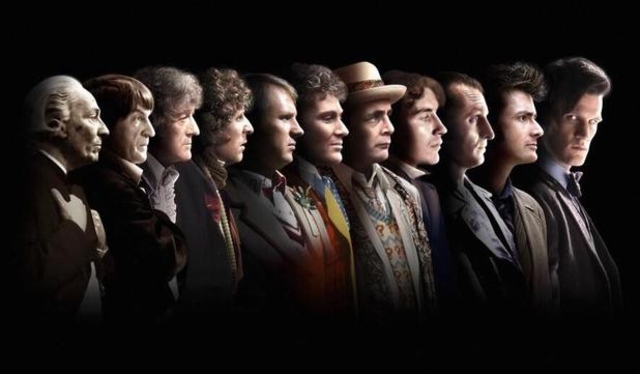
One man, eleven faces.

At the time of this writing, there have been 11 men who have played the Doctor in the main story (sorry, Peter Cushing and John Hurt!). If you ask a proper Whovian who the worst Doctor of the lot was, they might have a hard time answering. We all have our favorites, which can naturally eclipse some of the other incarnations of that most famous of Time Lords.

Here’s the cool part…even the weakest versions of the Doctor are still incredibly well played on screen. Each actor brought something to the role that stood out from his peers.  From William Hartnell’s First Doctor to Matt Smith’s Eleventh Doctor, the performances have been outstanding from start to finish. Even when the sets and special effects were not all that stellar, each Doctor was still uniquely brilliant. No pressure, Peter Capaldi. Your Twelfth Doctor has some pretty big shoes to fill.

He’s Universally Applicable to…Everything

doctor-plumber-gi-thumb-296x197

Anyone surprised? Anyone?

With a ship that can travel to any point in time and space, the Doctor could quite literally show up anywhere.  There have been some limited crossovers with other series (mostly in comics and novels), but it would not be out of character for a blue box to just materialize in just about any other sci-fi universe or continuity. Believe it or not, there is a comic book storyline where the Eleventh Doctor teams up with Jean-luc Picard and the crew of the Enterprise-D to fight a bunch of Borg/Cybermen hybrids. Yeah, my geek is showing.

But even within the confines of the show, we see the Doctor meet historical figures from Shakespeare to Madame de Pompadour. Whether he lands in Victorian England (which he does quite a bit), Renaissance Italy or Pompeii, there really is no storyline − past or present − that the Doctor couldn’t participate in. He just sort of goes with everything, and it’s glorious. The adventure possibilities are truly limitless.

_________________________________________________________

So there you have it, folks. In broad strokes, those are the reasons why this author loves the Doctor. If you are a science-fiction fan of any stripe, and haven’t watched this show, I can’t recommend Doctor Who enough to you.  In my opinion, the Doctor is one of the cornerstones of sci-fi, and is well worth discovering for yourself if you haven’t already. Who knows, you might just find yourself cruising ThinkGeek for a TARDIS mug or Dalek ice cube tray.

Allons-y!

__________________________________________________

Do me a favor, okay? Subscribe to my newsletter for more news, updates, and information on Sector M’s current and upcoming projects!


Continuity in Sci-Fi

In this author’s opinion, continuity is the glue that holds a sci-fi universe or series together. When I speak of ‘continuity’ in this sense, I’m not talking about whether an actor looks the same from one shot to another, or that the level of someone’s drink doesn’t fluctuate between scenes. No, I’m talking about a storyline that keeps itself internally consistent.  I’m a super stickler for that kind of thing. Why?

Science fiction already requires some help to suspend the reader or viewer’s disbelief. We’ve got aliens, flying cars, faster-than-light travel and all that good stuff we don’t have running around in real life. When the boundaries of that continuity are smooth and seamless, it makes it a heck of a lot easier to swallow the concept of Klingons, lightsabers and giant robots.

Taisun-largest-crane-1

This is one of the largest cranes in the world.
Sometimes even this isn’t enough to suspend my disbelief.

But when the continuity is sloppy or inconsistent, when the established rules of that universe are lazily ignored, the cracks show through in a hurry. It reminds us that we’re not peering off into some other distant time and place, but rather that we’re looking at a bunch of actors standing around on a set made of plastic and wood. Sci-fi movies, novels, TV shows, and comic books all desperately need a solid continuity just as a given. It’s the foundation on which the story is built. Build a house on a faulty foundation, and well, you get the idea.

So, here are three examples from sci-fi where the continuity frayed with varying degrees of consequences. Here we go…

Terminator 2: Judgment Day

First off, I love this movie. James Cameron is my favorite action director, hands down, and I think this movie is some of his finest work. His stories tend to be pretty well thought out, which is why this continuity slip irks me. In the first Terminator movie, Kyle Reese tells Sarah Connor that time travel is only possible due to ‘a field generated by a living organism.’ This explains why Kyle arrives in 1984 wearing only his birthday suit  with no futuristic equipment like plasma pulse-rifles, etc. The Terminator itself is a machine, but its endoskeleton is covered with actual living tissue, so that explains that, right?

In T2, however, the T-1000 comes through just fine. Even though it appears to be a man (and still arrives naked), its entire body is actually made of a liquid metal (a mimetic polyalloy if you want to get technical). There’s nothing organic about it, at least nothing that’s ever revealed to the audience. So, how exactly did it travel through time?

600px-T2StanWinstonT-1000shotgunhead

If I can shapechange into anything, why was I naked when I arrived?

Granted, we get all of our information about time travel from Kyle, who admits he doesn’t ‘know tech stuff,’ but it still causes a wrinkle. Even if it doesn’t destroy the movie for me (and it doesn’t), it still reminds me that someone wasn’t paying attention to their own canon.

Battlestar Galactica “Hero”

This episode of the reimagined Galactica series is from the notoriously wobbly Season 3. I’m not sure what happened to this show. It went from being some of the best sci-fi I have ever seen on television to a show that was almost painful to watch near the end. Season 3 was really where the continuity of the show wore thin, and this episode pretty much sums it up for me.

If you haven’t seen it, let me explain: So, Admiral Adama (Edward James Olmos) is being awarded a medal for his years of meritorious military service. Adama, however, harbors a secret that’s been tearing him up inside. We get a flashback to when he commanded the Battlestar Valkyrie a year before the 13 Colonies of Cobol were destroyed. It turns out that he may have been the one who inadvertently touched off the war with the Cylons (or so he suspects), which resulted in billions of deaths. So, being awarded a medal for heroism cuts him like a knife. It is full of angst and regret, moving background music, and it’s exquisitely acted by a veteran cast.

4170392_std

Wait, where was I again?

So what’s the problem? Well, it had been established previously that Adama had been in command of the Galactica for several years leading up to the outbreak of war. So how could he have been on the mission with the Valkyrie, when he was already firmly stationed on Galactica? Whoops! Someone needed to keep track of their timeline a little better, huh? It undermined the entire episode, and quite frankly, the show would have been better off as a whole if it had been left out.

Star Trek: Enterprise

My first example was pretty minor.  My second was pretty bad…but the last is one of the worst offenders I can think of – Star Trek: Enterprise.  Not just one episode, nor even one season, but the entire series from start to finish.  It’s one of the most glaring continuity errors in science fiction history. Why is that?

The series takes place in the timeline well before Kirk and Spock, serving as a prequel to the other Star Treks. The Enterprise in this Star Trek series is touted as the first human-manned ship to leave our solar system. In fact, that’s a major part of the show’s pilot episode. For her time, she’s supposed to be the most advanced starship ever built by human hands, and is supposed to have started the legend that later starships named Enterprise would build upon. James T. Kirk, John Harriman, Rachel Garrett and Jean-Luc Picard all stand upon its shoulders, right?

Enterprise_legacy

Nope, not there.

So why is there no mention of it before this series? Wouldn’t a ship occupying that singular place in human history be mentioned before that somewhere? Well, in the conference room aboard Picard’s Enterprise-D, you can see the outlines of past ships bearing that name. There’s a string of ships from the aircraft carrier, to Kirk’s original ship, then the A, the B, and up through D.

So where is the Enterprise-NX in all of that? It’s suspiciously absent from the lineup. That’s because the showrunners made her up on the spot without much consideration for what history had already been established for the show. They could have chosen any other name for the ship and been okay. The Valiant, the Constellation, the Good Ship Lollipop, S.S. Minnow – anything, and it would have worked out just fine. But no, they just had to go and name her Enterprise, didn’t they?

And this show ran for 5 seasons.

405572

Braaaaaaaaggggaaaaaa!

Yeah, that was pretty much what I thought, too.

So, is all of this needless nitpicking by a fan who should really find something else to do with his time? Probably. I’ll admit that I speculate and ponder things like this quite a bit, and when there’s a mistake, I generally find it.

It’s not for the purpose of harping on it, to point fingers at the creators/authors and say, “Ha Ha!” like Nelson from the Simpsons. No, it’s because when I want to immerse myself in sci-fi, I want to believe on some level that what I’m reading or seeing could exist out there somewhere in the past, present or future, and share in that discovery or adventure. A consistent continuity allows me to do that; a faulty one reminds me that I’m just some poor schlub with a Netflix account.

__________________________________________________

Do me a favor, okay? Subscribe to my newsletter for more news, updates, and information on Sector M’s current and upcoming projects!

Scalability

One of the hardest things about writing sci-fi (IMHO) is handling the technology. All too often the real world will catch up to science fiction levels in just years rather than centuries.  I may write about such things as invisibility fields or nanotechnology when all the while they may be just around the corner. Just do a google search for either of those, and the tech in the pages of a sci-fi novel may not seem so far off.

Even though we don’t have flying cars (yet), I am continually surprised at the things that modern scientific research discovers every day.  I mean, in the next few years, we might actually have found the Higgs-Boson particle or developed hand-held energy weapons, personally cloned organs, powered exoskeletons and life-extending treatments and/or drugs – all things that previously existed only in theory and imagination.

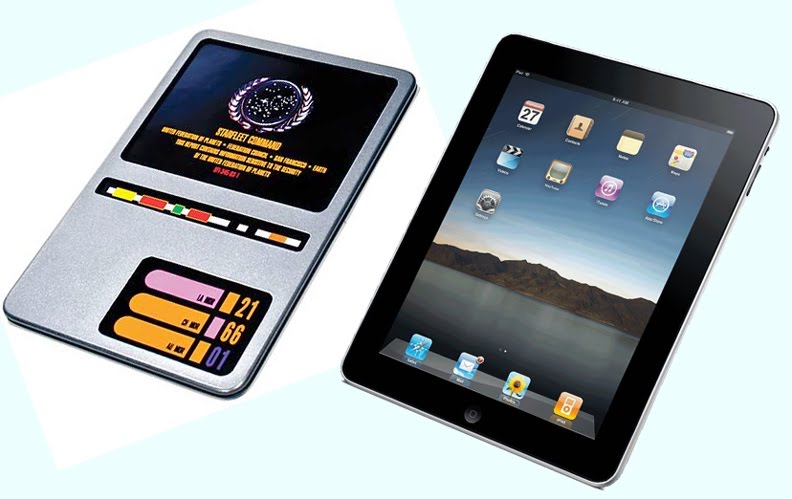
padd

Okay, Star Trek, we’re looking in your direction.

So what’s a lowly sci-fi writer to do to make sure that actual technology doesn’t exceed the set pieces that he creates? It might be a peek behind the curtain, but I’ll share with you one of the techniques I use on a pretty regular basis.

Scalability.

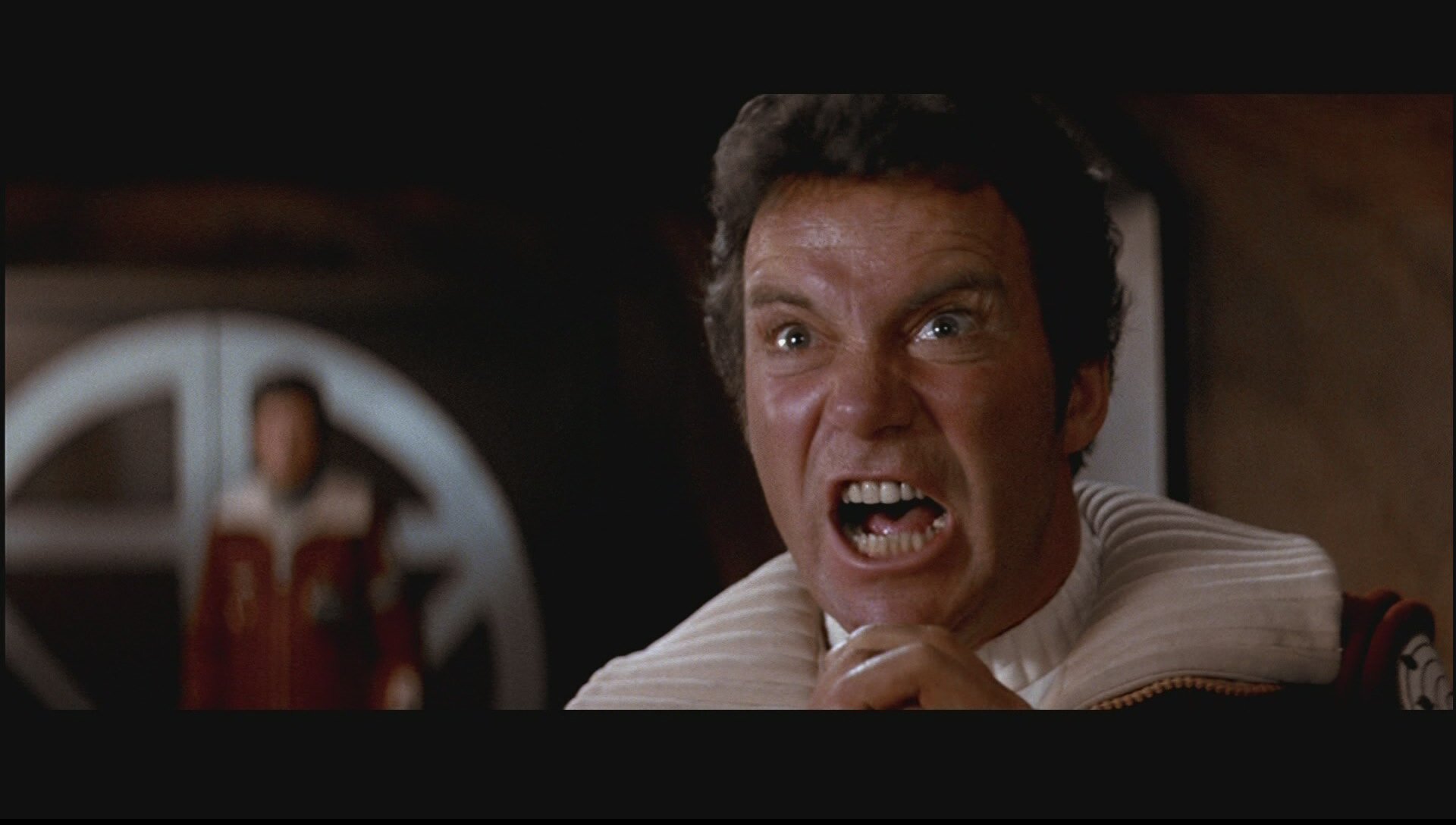
Let me give you an example of when this was not used. In the novelization of Star Trek II: The Wrath of Khan, we get a few scenes that do not appear in the movie. Consequently, we get to know some of the scientists aboard space station Regula 1. As it turns out two of the scientists are game designers, and they have just completed work on their latest video game, Boojum Hunt. It was supposedly the largest video game ever (by 23rd century standards) in terms of how much computer memory it occupied. It was so large that the computer mainframe of the space station only barely contained it.

Any guesses how at much space it took up? 60 Megabytes.  Megabytes with an ‘M.’ Yeah, it’s safe to say that modern technology blew that one completely out of the water. At the time of the novel’s release, 60MB might have seemed unthinkably enormous, but nowadays not so much.

Flash Drive

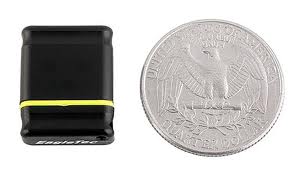
This flash drive holds 32 gigabytes.

Consider this, though − what if the novel had just said that the game was the “largest video game ever created,” and left it at that? Chances are someone reading it today would scale their expectations up to whatever the norm is currently. The same goes for someone reading it twenty years from now.

That’s scalability. It’s presenting a concept without the parameters that will eventually invalidate it. That way, it scales up to whatever the reader expects it to be. Certainly  Boojum Hunt’s claim would have held up without that troublesome measurement to sink it.  So, this idea can be applied to practically any claim we put on sci-fi set-piece technology. Saying, “A warship of the highest magnitude,” tells you everything you need to know in only a few words in the same way that saying, “She was the most beautiful woman he had ever seen,” can describe a character.  It’s a bit of ‘smoke and mirrors’ to handle it that way, and you do wind up speaking in superlatives quite a bit, but it works.

Social_Marketing_See_Behind_Curtain_Transparency

Hey, no peeking behind the curtain…ah, okay, just this once.

So what happens when you need to put some sort of real-world perspectives on your tech? Well, you can do that. Hard science fiction does it all the time, but they run the risk of being shown up by the onward march of human ingenuity and understanding.  For the sake of argument, let’s say that you have to put something down for one of your gadgets.

Here’s what I would do: I would figure out the modern measurement equivalent and then either quintuple or sextuple the order of magnitude.  I ran into a situation like this in The Backwards Mask when I had to give an indication of how large a particular hard drive was aboard the Hornet.  I didn’t want to make the same mistakes as Boojum Hunt, so I first thought of how large the ‘Canary Drive’ was in 21st century terms. I’m used to thinking of gigabytes (109 bits) in the here and now, so I then kicked it up to yottabytes (1024 bits). BTW, a single yottabyte equals a quadrillion (1,000,000,000,000,000) gigabytes.

original

That’s a big Twinkie.

As astronomical as that number may seem, there may come a day when devices store hundreds of yottabytes of information, and it’s no big deal anymore. They might look at my description of the Canary Drive and laugh to themselves at my short-sightedness.  Well, I think I’ve bought myself a few decades before that happens. If folks are still reading my book in 30 to 40 years, I still call that a win.

So, what’s the upshot of all this? I consider scalability an important tool in my writer’s toolbox. You can use it to bring technology up to the reader’s level of understanding (truly state-of-the-art) so it doesn’t get overrun by actual science quite as easily.  Of course no science fiction is bulletproof, but scalability at least allows it wear to Kevlar.

__________________________________________________

Do me a favor, okay? Subscribe to my newsletter for more news, updates, and information on Sector M’s current and upcoming projects!

Sci-fi’s Strongest Heroine?

Female characters in science fiction have come a long way since the pulp-era days. No longer are they always the cliché ‘maiden in distress’ or merely a means to have a love interest in the story.  Oh, there’s still quite a lot of that goes on, but it’s not quite so omnipresent throughout the genre anymore.

Speaking as an author, I love strong female characters (both reading and writing them). I feel privileged to live in a generation of great sci-fi heroines. We’re talking names such as Nyota Uhura (past and present), Ellen Ripley, Katie Sackoff’s Starbuck, Katniss Everdeen, Honor Harrington, Buffy Anne Summers (or practically any female character from Joss Whedon’s brain), Dr. Dana Scully, Sarah Connor, Susan Ivanova…the list goes on and on.

947010_517880768248241_141481184_n

OOOH YEEEAH…
*said in the Kool-Aid Man voice.*

These are the ladies who don’t need anyone to make them powerful, because they are already.  Helen Reddy songs would not be out of place blasting in the background as they go about saving civilization, humankind or the universe.

In this author’s humble opinion, there is one leading lady who takes the crown of strongest sci-fi heroine, and, wow, talk about a tough choice! But if I had to pick just one it would be…(drum roll)…Trinity from The Matrix.

jumpkick288

Hear me roar…and soar, apparently.

Note that this is the Trinity from the first Matrix movie, not the ones that followed. Sure, she was cool in those too…in the same way that Connor McLeod was also cool in Highlander 2: The Quickening. Cool, but just not the same. For the sake of this post, forget that the Reloaded and Revolutions movies ever existed. I do.

Here are the top three reasons I think this, along with the stereotype that Trinity shatters with a ‘bullet time’ slow-motion jump kick.

1.) She Looks Like She Can (And Will) Kick Your Butt

5-the-matrix-trinity-dodge-this_thumb

Dodge this.

The first scene in The Matrix shows her taking out several SWAT team guys with martial arts moves that border on anime. I remember the first time I saw this in theatre. I was completely sold on the character’s capacity to kick butt.  Carrie-Anne Moss was in incredible physical shape in that role, and she completely owned the physical stunts necessary to convince us of Trinity’s formidable hand-to-hand skills.

Have you noticed in the movies how many times we see a rather diminutive female character going toe-to-toe in a fistfight with goons more than twice her size and weight? Yet she wades through tons of them as though they were nothing. Does that really seem believable to you? Most of the time it looks pretty forced, leaving many of us thinking um, what? With Trinity, her combat abilities don’t seem out of place at all. Once you know that she can bend the Matrix, it makes even more sense that she can go through even highly trained special ops-types without breaking a sweat.

2.) Not Just Another Pretty Face

trinity-matrix

Whoah…

Carrie-Anne Moss (and thus Trinity) is beautiful, no doubt about it. At no time in the film, however, was she so glammed out that she no longer fit the role. Trinity comes from a dark and hard world, one where she risks her life on a daily basis to fight a system that has enslaved humanity without its knowledge.  If she couldn’t pull her own weight on missions, she wouldn’t have survived for so long. In that sense, she doesn’t suffer from “Bond Girl” syndrome, where her usefulness and contribution to the story are just skin deep.  Quite the opposite, in fact − she’s integral to the story.

Also, Trinity is uber competent at what she does. Even after Ted “Theodore” Logan came along to become the Kwisatz Haderach, she remains one of Zion’s elite operators.  When Neo goes in to rescue Morpheus, who’s the other half of the assault team, in what was surely a suicide mission, the one he could not have done it without? Sorry, rhetorical question.

3.) Her Femininity Doesn’t Clash

tumblr_mi6ln1hZb01qmwg3ao1_500

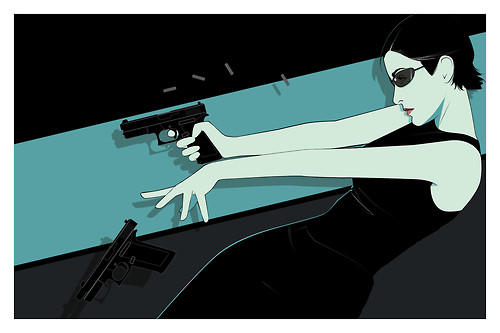
Trinity à la Nagle.

Okay, ladies, here’s a question for all of you. Does it feel like some female characters are stripped of their femininity when they are put in what would be traditionally considered a ‘man’s’ role? It’s almost as if the idea of a woman who knows how to mix it up in a brawl or a firefight can’t be considered womanly.

I disagree with that idea, of course. More than that, I disagree with the underlying assumption that puissance at arms is something uniquely masculine, or (more to the point) not feminine. While The Rules would not approve of ladies who know how to field strip an M-16, set explosives or do anything else a Navy SEAL might be trained in…I do. For me, femininity and masculinity are not about what you do, but who you are.

In the case of Trinity, she is very much a woman. At no time does she come off as mannish or butch, and she doesn’t need to adopt the caricature of male persona to be brave in the face of nearly impossible odds, or to fight for her cause or for those she loves. She doesn’t have to give up one to have the other, and I love her for that.

So that’s how I see it. Of course, I’m a guy, so me going on about all this might be comical to some of the ladies out there. Let’s just remember that this is an opinion piece, after all.

What do you think?

__________________________________________________

Do me a favor, okay? Subscribe to my newsletter for more news, updates, and information on Sector M’s current and upcoming projects!


Backwards Compatible – Part 1: Genesis

You knew it was coming…the inevitable post about my novel. This is, in fact, the first in a series of posts explaining how my novel came about.  The road from its inception to execution was a long and twisting one.

Well, let’s start at the beginning.

header-1161698270

No caption required, really.

In the mid-90s, Games Designers’ Workshop (hitherto referred to as GDW) launched their expansion to the popular Traveller RPG universe, entitled “Traveller: The New Era.” Unlike previous milieus of the game, which centered around a massive star-spanning Empire, this one was post-apocalyptic. Now I’m not talking your run-of-the-mill Mad Max/Tina Turner post apocalypse. No, this was devastation on an interstellar scale.

In the time period of The New Era, the great Empire is toast, laid waste thanks to an insidious, self-aware computer virus that makes Skynet look shy and retiring by comparison. The virus (appropriately named “Virus”) has ravaged the Empire and its citizens, leaving trillions dead in sector after sector of smashed and ruined worlds.

skynet

Geez, I’m bad, but not that bad.

Yet not all hope is lost. There are little islands of civilization among the vast ocean of cemetery worlds and boneyards that struggle to recover in the wake of the worst calamity in all of human history. It’s an uphill climb for the survivors to avoid a descent into barbarism and darkness. If that weren’t enough, Virus is still out there, waiting to finish what it started. Civilization itself hangs by a very thin thread.

Pretty bleak stuff, huh? Well, many fans of Traveller thought the same thing, including yours truly. The epic scope of the previous settings shrank dramatically. Instead of focusing on an empire of 11,000 star systems, the new setting introduced the Reformation Coalition, a small polity with a little over 20. It was a controversial move and one that would divide fans of the ‘classic’ Traveller universe from those of the New Era to this day.

sci-fi-post-apocalyptic-28081_942730_1492542

Welcome to the new age, to the new age.
I’m radioactive, radioactive.

To promote this new setting, GDW added a trilogy of science fiction novels to their lineup to explore the setting in detail.  Paul Brunette was chosen to tackle this project. He produced The Death of Wisdom and To Dream of Chaos. Before the third novel − The Backwards Mask − could be commissioned, however, GDW went out of business. The New Era trilogy went into limbo.

Years passed, until I happened to meet Marc Miller (the creator of the Traveller universe) at a convention. At the time I was working as a writer for a game company. Though I was just a fan, Marc took the time out of his busy schedule to sit and talk with me. There was a great richness to the Traveller universe that I felt lent itself to fiction, and Marc agreed. After the convention, we started an email dialogue where we discussed possible Traveller fiction ideas. It was during this time that Marc dusted off the unfinished TNE trilogy and offered me the chance to write the third installment.

Of course, I jumped at it.

[Check out the Backwards Mask on Kindle.]

__________________________________________________

Do me a favor, okay? Subscribe to my newsletter for more news, updates, and information on Sector M’s current and upcoming projects!


Why Sci-fi?

Speculative fiction is my ‘thing.’

Fantasy, horror and sci-fi constitute the big three in my book.  They make up a disproportionately large segment of what I love to read, write and watch on TV and movies.  They resonate with the kind of headspace I seem to occupy most of the time. I lovelovelove all three, however, sci-fi is my favorite.  I can say with all certainty that it’s what I love to write more than anything else.

Why is that? Why do starships, aliens and planets trump elves, magic swords and dragons…or blasphemous books, tentacles and the shrieking, ineffable void?

There are a few reasons for this, which I will explain here (the top three, at any rate).  Now realize that this isn’t a case for why sci-fi is better than fantasy or horror, merely why I’m drawn to it as a genre.

1.) Just a Spoonful of Sugar

It’s amazing the amount of social commentary science fiction can pull off without the ruffled feathers you would get if you talked about the same thing in ‘real life.’ In that way, science fiction is an excellent way to talk about something without really talking about it.

Think about it, we can talk about religion, politics, man’s inhumanity to man and the horror and/or necessity of war – all things that can make people truly uncomfortable − if we couch it in a futuristic setting.  It somehow insulates us from the pricklier bits of what the story is trying to get across.

More than that, it’s a way for us to step back from our daily lives and look at some of the problems that surround us today. Even if the story takes said issue/problem/social inequity out of context, we still come away with a (hopefully) new perspective.

A prime example of this is the original series Star Trek episode, “Let This Be Your Last Battlefield.” It starred Frank Gorshin, known for his role as the Riddler opposite Adam West as Batman.  Frank’s character, Commissioner Bele, is tracking a fugitive, Lokai. Bele believes that Lokai and his kind are of an ‘obviously inferior breed.’ Why? Bele’s face is white on the left side and black on the right. Lokai’s color scheme is the reverse. To human eyes, the two aliens look just alike, but this difference of appearance is responsible for incredible amounts of destruction and social upheaval on their home planet of Cheron.

Okay, so the message isn’t exactly subtle; it makes its point with a jackhammer. Even so, it speaks directly to the racial division and strife that was rampant in the 1960s. Do you think that any straight-laced TV show of that time could’ve talked about that issue so openly? Likely not.

STLastBattle

Okay, Frank, we get it.

2.) Possible Futures vs. Alternate Worlds

Most science fiction takes place in the future.  This might seem like stating the blatantly obvious, but there’s something to that. It takes place in the future − our future.

Usually sci-fi stories use the timeline of our real world as a foundation, or at the very least they don’t do away with it completely. Yes, there are always exceptions, such as Star Wars, but I’m talking in general.

For me, the most engaging science fiction stories are the ones that feel like I could jump in my time-travelling DeLorean or blue police box, dial it forward to the proper year and boom, I’m right there in the thick of things. I don’t have to reimagine the world from scratch, I just have to fill in the missing years between when I’m reading the book and the time period of the story.

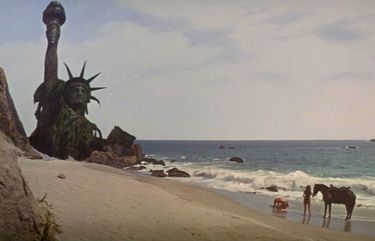
Consequently, sci-fi feels very organic. It shows you possible futures rather than a completely alternate world that is separate and apart from the one we live in. In this way, sci-fi calls to me a bit more than the fantasy genre. Only in rare cases, such as Lord of the Rings or Conan, is a fantasy story presented as a sort of lost ‘pre-history’ to our world.

So, even though sci-fi takes flight just like other types of fiction, it does so by using us as a springboard.

planet-of-the-apes-statue-of-liberty-blu-ray-disc-screencap-hd-1080p-05

Lady Liberty — the sci-fi landmark of choice.

3.) The More Things Change

The humans populating science fiction universes are a lot like us. Even if they live hundreds or thousands of years in the future, they are still understandable to those of us in this time.  Sure, future generations may have figured out a lot of things that we haven’t, such as FTL travel, overcoming disease and hunger, etc. They may even have co-ed showers because gender roles are no big deal anymore.

But they haven’t figured it all out. Most of the time they still have to contend with greed, arrogance, anger, jealousy, hatred, betrayal, war and host of other things that are problematic for us today. Maybe they go to a job but don’t like their boss, or they grapple with the fundamental questions of our existence and place in the universe. They may have access to a host of technological toys that we don’t, but seldom are they that much more advanced than we are right now.

There are reasons for that, of course. The most obvious is that science fiction is written by authors who are relatively contemporary to us. I choose to think of it in a different way, though. I like to think that the inhabitants of the future are like us because that allows us to project ourselves in their place.  If only we had the same training and access to technology, we might be able to trade places with them.

I think that feeling is essential in creating that sense of place in any good science fiction story. I’m convinced that it’s a big part of what draws us into that universe, and keeps us there.

a_025HicksApone

Some things change.
Marines don’t.

Well, there you have it, folks. I could go on and on, but those are the things that give science fiction a special place in my heart. Of the three branches of speculative fiction, it’s the one that seems the most inclusive to the reader just as we are.

I’m sure that purists of fantasy and horror are even now lining up to point out the flaws in my reasoning. Do you agree with me, disagree or are you just sort of ‘meh’ about the whole deal?

Leave me a comment and let me know what you think.

__________________________________________________

Do me a favor, okay? Subscribe to my newsletter for more news, updates, and information on Sector M’s current and upcoming projects!